Game Programming Patterns by Robert Nystrom. В книге рассматриваются различные шаблоны проектирования, применительно к геймдеву. Это не что-то новое, а просто удобная подборка с примерами и доступным описанием. Крайне рекомендую к прочтению, читается и воспринимается книга легко.
Краткий список шаблонов, которые рассмотрены в книге: Command, Flyweight, Observer, Prototype, Singleton, State, Component, Event Queue и прочее.
На английском языке книга доступна в разных форматах на сайте автора. Есть и исходники, и переводы на русский язык.
Английская версия (оригинал) в различных форматах, включая бумажный вариант
This is one of the essential tools I use daily, helping me eliminate a significant amount of routine work.
Yes, it happens – I actually use my own creation daily.
Texture Packer for Linux and macOS is a command-line utility that packs multiple input images into a single texture atlas. Its CLI nature makes it ideal for automation in various workflows.
Features
It’s quite fast’ve compared it to a “standard paid” packer.
It accepts both individual sprites and entire directories as input, with support for recursive directory processing.
It can generate Power-of-Two (PoT) atlases.
You can limit the maximum size of the atlas.
It can trim “excess” border pixels from input sprites.
It can add a border of a specified size around a sprite when placing it in the atlas.
It generates an XML file with the layout description of the placed sprites.
The utility was originally created for personal use, but is now available on GitHub – Texture Packer.
I check the logs of my web server fairly often, though not very closely. Referrers are particularly valuable to me. Usually, I’m aware of all the reviews related to my games, but this review came as a complete surprise…
The modern boom in Arkanoid-style games arguably began back in 1997 with DX-Ball. It’s not that the game brought much new to the genre — it was simply made very well, and its popularity can be explained by the clever use of Microsoft DirectX’s technological capabilities.
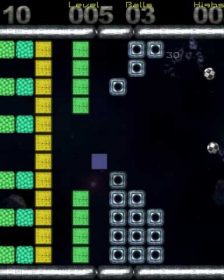
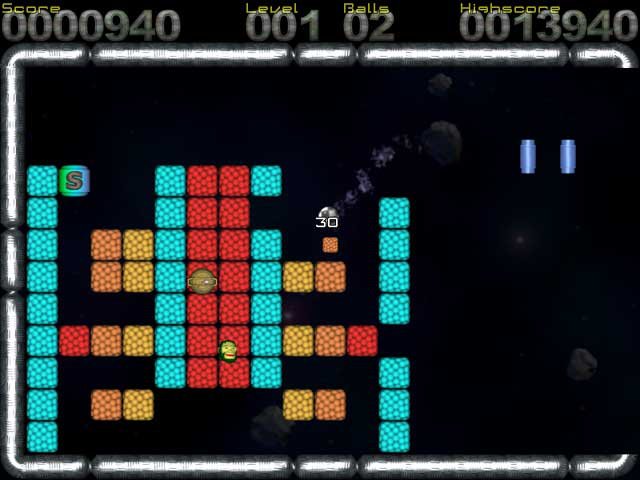
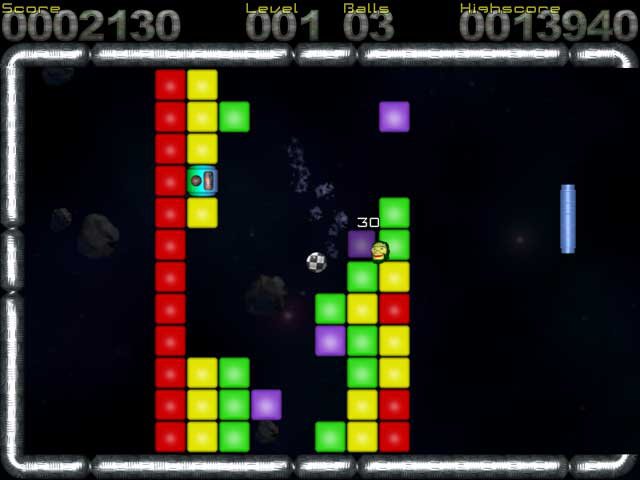
Following the same technological path were the developers from the ‘WE’ Group, who released Krakout RE. To be fair, this game isn’t based on the original Arkanoid, but on a later clone — Krakout, which was once well-known among ZX-Spectrum, Commodore 64, and Amiga users. The authors managed to create a visually stunning game that actively uses the power of modern graphics cards and delights the eye with pleasant animated graphics.
A key feature of the game is its unique level generator. Essentially, the game is endless, as completely new levels are created each time you start it. Also noteworthy are the excellent musical soundtrack, the ability to save your game, and the option to share your achievements with other players by publishing results online.
In addition, the authors added several original bonuses that don’t “drop” from broken bricks but remain in place. For example, among negative bonuses, you might encounter a cannon that shoots at your paddle and freezes it upon impact.
To provide the best experiences, we use technologies like cookies to store and/or access device information. Consenting to these technologies will allow us to process data such as browsing behavior or unique IDs on this site. Not consenting or withdrawing consent, may adversely affect certain features and functions.
Functional
Always active
The technical storage or access is strictly necessary for the legitimate purpose of enabling the use of a specific service explicitly requested by the subscriber or user, or for the sole purpose of carrying out the transmission of a communication over an electronic communications network.
Preferences
The technical storage or access is necessary for the legitimate purpose of storing preferences that are not requested by the subscriber or user.
Statistics
The technical storage or access that is used exclusively for statistical purposes.The technical storage or access that is used exclusively for anonymous statistical purposes. Without a subpoena, voluntary compliance on the part of your Internet Service Provider, or additional records from a third party, information stored or retrieved for this purpose alone cannot usually be used to identify you.
Marketing
The technical storage or access is required to create user profiles to send advertising, or to track the user on a website or across several websites for similar marketing purposes.